

A Simple Weekly Workout Plan:
Starting a fitness routine can feel confusing when you are not sure which exercises to do, how often to train, or whether you need a gym. The good news is that you do not need an advanced workout programme to become more active. The best fitness routine for beginners is one that is simple, realistic, enjoyable, and easy to follow consistently.
For most healthy adults, a balanced routine should include aerobic activity, muscle-strengthening exercises, and enough recovery. Current U.S. physical activity guidelines recommend at least 150 minutes of moderate-intensity aerobic activity per week plus muscle-strengthening activities on at least two days per week. You do not have to reach that target immediately; starting gradually is a practical approach for beginners. This guide explains how to build a beginner workout routine at home or in a gym, which exercises to start with, how to structure your week, and how to make your routine sustainable.
What Is the Best Fitness Routine for Beginners?
The best fitness routine for beginners is a balanced workout plan that develops basic strength, cardiovascular fitness, mobility, and exercise consistency without overwhelming the body.
A beginner does not need to exercise for hours every day. A practical starting routine may include:
- 20–30 minutes of brisk walking or another form of cardio
- Two beginner strength-training sessions each week
- Simple bodyweight exercises
- Short mobility or stretching sessions
- Rest or light-activity days
- Gradual increases in exercise time or difficulty
The important point is consistency. Doing a manageable workout several times a week is generally more sustainable than starting with an intense programme and quitting after a few days.
The Centers for Disease Control and Prevention notes that some physical activity is better than none and recommends gradually working toward the weekly activity target.
Why Should Beginners Start With a Simple Workout Plan?
When you are new to exercise, your body needs time to adapt to physical activity. Starting with complicated exercises, very heavy weights, or excessive cardio can make the routine difficult to maintain.
A simple beginner fitness plan has several advantages:
- It is easier to learn proper exercise technique.
- It allows you to monitor how your body responds.
- It makes progress easier to track.
- It reduces the temptation to do too much too soon.
- It can be performed at home with little or no equipment.
- It creates a foundation for more advanced training later.
Your first goal should not be to complete the hardest workout. Instead, focus on building the habit of moving regularly.
A Simple 7-Day Beginner Fitness Routine
Here is an example of a balanced weekly schedule. You can adjust the days according to your lifestyle, fitness level, and available time.
| Day | Workout | Beginner Duration |
| Monday | Brisk walking + mobility | 25–30 minutes |
| Tuesday | Full-body strength workout | 20–30 minutes |
| Wednesday | Easy walk or active recovery | 20–30 minutes |
| Thursday | Brisk walking or cycling | 25–30 minutes |
| Friday | Full-body strength workout | 20–30 minutes |
| Saturday | Longer walk or enjoyable activity | 30–40 minutes |
| Sunday | Rest or gentle stretching | 10–15 minutes |
This schedule is an example rather than a requirement. Beginners who are currently inactive can begin with shorter sessions and gradually increase their activity.
Monday: Start With Walking
Begin the week with an easy-to-moderate walk.
Try:
- 5 minutes of comfortable walking
- 15–20 minutes of brisk walking
- 5 minutes of slower walking
Brisk walking is a convenient form of moderate-intensity aerobic activity. One useful practical sign of moderate intensity is that you are breathing harder and can talk but may not be able to sing comfortably.
Tuesday: Full-Body Strength Training
Strength training does not necessarily require a gym. Beginners can use bodyweight movements or light resistance.
Try one set of each exercise to start:
- Bodyweight squats — 8–12 repetitions
- Wall or incline push-ups — 8–12 repetitions
- Glute bridges — 10–15 repetitions
- Bird-dogs — 8–10 repetitions per side
- Standing calf raises — 10–15 repetitions
- Light resistance-band rows — 8–12 repetitions
Rest when needed and concentrate on controlled movement rather than speed.
For muscle-strengthening exercises, the CDC describes 8–12 repetitions as a common range for a set and recommends exercises that work the major muscle groups.
Wednesday: Active Recovery
You do not need to spend every day doing a hard workout.
An active recovery day could include:
- Easy walking
- Gentle stretching
- Light household activity
- Beginner yoga
- Mobility exercises
The purpose is to keep moving without turning every day into a demanding training session.
Thursday: Cardio Day
Choose a cardiovascular activity that you actually enjoy.
Options include:
- Brisk walking
- Cycling
- Swimming
- Dancing
- Low-impact aerobic exercise
- Easy jogging if your fitness level allows it
Start at a comfortable intensity. If you have been inactive for a long time, there is no need to begin with running.
Friday: Repeat Full-Body Strength Training
Repeat the Tuesday workout.
If the exercises feel easy and your technique is controlled, you can gradually increase repetitions, resistance, or difficulty over time. Do not feel pressured to increase everything at once. Progress can be small.
Saturday: Enjoyable Movement
Saturday can be your flexible activity day.
You could:
- Take a longer walk
- Go cycling
- Dance at home
- Play a recreational sport
- Go swimming
- Take a nature walk
Choosing activities you enjoy can make it easier to remain physically active over time. The CDC specifically recommends choosing activities that match your abilities and that you enjoy.
Sunday: Rest and Recovery
Rest is part of a fitness routine. You can completely rest or do gentle stretching and easy movement if it feels comfortable. A beginner does not need to feel guilty about taking a recovery day.
Best Beginner Exercises to Do at Home
One of the biggest advantages of beginner fitness is that many effective movements require little or no equipment.
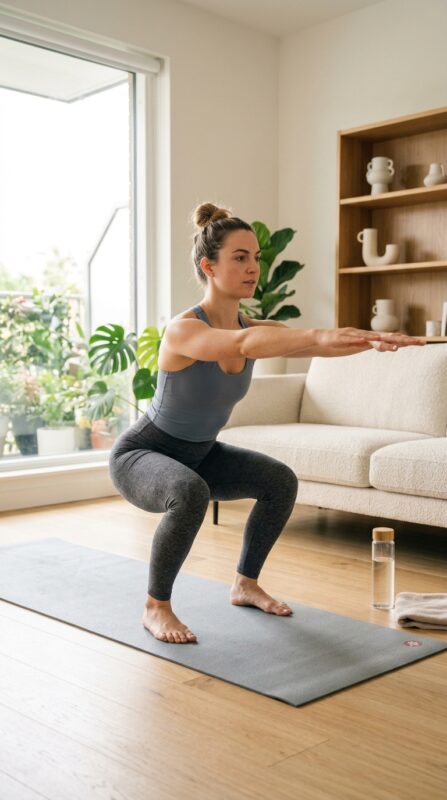
Bodyweight Squats
Squats train the muscles around the legs and hips.
To perform a basic squat:
- Stand with your feet approximately hip-width apart.
- Keep your chest comfortably upright.
- Bend your knees and hips.
- Lower yourself only as far as you can comfortably control.
- Push through your feet to return to standing.
If a regular squat feels difficult, use a chair for support.
Wall Push-Ups
Wall push-ups are a beginner-friendly alternative to floor push-ups. Stand facing a wall, place your hands against it, and slowly bend your elbows to bring your body closer to the wall. Push away while keeping your body controlled. As you become stronger, you can progress to an incline push-up and eventually a floor push-up if appropriate.
Glute Bridges
Glute bridges can be performed on the floor and require no equipment. Lie on your back with your knees bent. Keep your feet planted, lift your hips in a controlled manner, and lower them slowly. Avoid rushing through the movement.
Bird-Dog
Bird dogs involve extending the opposite arm and leg while maintaining a stable position. They can be useful as part of a beginner movement routine because they challenge coordination and core control. Start with a small range of movement and prioritise stability.
Calf Raises
Stand near a wall or sturdy surface for balance. Slowly raise your heels, pause briefly, and lower them under control. This is a simple movement that can be performed almost anywhere.
How Long Should a Beginner Work Out?
There is no single workout duration that is perfect for everyone. A person who is completely new to exercise may start with 10–20 minutes, while someone who already walks regularly may comfortably begin with 20–30 minutes. The long-term goal for healthy adults is at least 150 minutes of moderate-intensity aerobic activity each week, plus muscle-strengthening activity on at least two days. These minutes can be distributed throughout the week rather than completed in one long session.
For example, you could eventually work toward:
- 30 minutes × 5 days = 150 minutes
- 20 minutes × 7 days = 140 minutes, plus additional activity
- Several shorter activity sessions spread throughout the day
If you cannot reach the recommended amount yet, start where you are and build gradually.
How Many Days a Week Should Beginners Exercise?
For many beginners, three to five active days per week can be a practical structure, depending on what those sessions involve.
A beginner might combine:
- 2 strength-training days
- 2–3 cardio or walking days
- 1–2 recovery days
You do not need five hard workouts. For example, a weekly routine could include two strength sessions, three walking sessions, and two recovery days. The exact schedule should fit your current fitness level, lifestyle, and health needs.
How to Warm Up Before Exercise
A warm-up prepares you mentally and physically for your workout. A simple beginner warm-up can take about 5–10 minutes and may include:
- Easy walking
- Arm circles
- Gentle leg movements
- Shoulder rolls
- Hip movements
- Gradually increasing the pace of your planned activity
The warm-up does not need to be exhausting. Its purpose is to transition gradually into exercise.
Should Beginners Stretch Before or After Exercise?
Gentle movement before exercise can help you prepare for the activity you are about to perform. Longer flexibility-focused stretching is often easier to include after training or during a separate mobility session. Beginner-friendly stretches may include:
- Calf stretch
- Hamstring stretch
- Hip-flexor stretch
- Chest stretch
- Shoulder stretch
Move slowly and avoid forcing a joint into an uncomfortable position.
How to Progress Your Beginner Workout
Progress does not mean making every workout harder. Instead, make small changes when your current routine becomes comfortable.
You might progress by:
- Adding a few minutes to a walk.
- Increasing repetitions slightly.
- Adding another set.
- Using a light resistance band.
- Increasing walking speed.
- Choosing a slightly more challenging exercise variation.
For beginners, gradual progression is important. Official physical activity guidance emphasises building activity over time, while exercise safety guidance from the American College of Sports Medicine also supports gradual progression for people with lower fitness levels.
Common Beginner Workout Mistakes to Avoid
Doing Too Much Too Soon
One of the most common mistakes is assuming that a harder workout produces better results. Beginners should give their bodies time to adapt. Instead of immediately attempting long workouts, start with manageable sessions and gradually increase your workload.
Copying Advanced Workouts
A workout designed for an experienced athlete may not be appropriate for someone who has never exercised regularly. Choose exercises that match your current ability.
Ignoring Technique
Good technique matters more than performing a large number of repetitions. If you cannot control an exercise, reduce the difficulty or repetitions.
Training Every Day Without Recovery
More exercise is not automatically better. A balanced plan includes easier days and recovery periods. Exercise programmes should be introduced progressively and include appropriate recovery.
Focusing Only on Cardio
Walking and other cardio activities are valuable, but strength training is also an important part of a balanced adult fitness routine. Adults are advised to include muscle-strengthening activity at least two days each week.
Beginner Fitness Routine for Weight Loss
If your goal is weight management, exercise can be part of a broader lifestyle approach. Physical activity increases the amount of energy your body uses, while nutrition also plays an important role in energy balance and weight management. The CDC notes that physical activity is important for maintaining a healthy weight and that combining physical activity with appropriate dietary intake can support weight management.
A beginner routine could include:
- Brisk walking 3–5 days per week
- Full-body strength training twice a week
- More daily movement
- A balanced eating pattern
- Adequate recovery
Avoid judging your progress only by the number on a scale. Fitness can also involve improvements in strength, endurance, mobility, energy, and consistency.
Beginner Fitness Routine for Women
Women can follow the same basic principles of cardiovascular activity and strength training.
A simple routine could include:
- Walking
- Squats
- Glute bridges
- Incline push-ups
- Resistance-band rows
- Calf raises
- Core-control exercises
- Mobility work
The best programme depends on the individual’s goals and fitness level rather than requiring a completely different approach simply because of gender. If someone is pregnant, recently postpartum, has a chronic condition, or has another health concern, exercise choices should be individualised with appropriate professional guidance.
Beginner Fitness Routine for Men
Men who are new to fitness can also begin with a simple combination of cardio and full-body strength exercises.
A beginner gym routine might include:
- Treadmill walking
- Bodyweight squats
- Machine or band rows
- Chest press or incline push-ups
- Light hip-hinge exercises
- Calf raises
- Basic core exercises
The priority should be learning movement patterns and developing consistency before chasing heavy weights.
Home Workout vs. Gym Workout for Beginners
You do not need a gym membership to begin becoming more active.
| Home Workout | Gym Workout |
| Little or no equipment | Wider range of equipment |
| Convenient | Access to machines and weights |
| Easy to fit into a busy schedule | Structured workout environment |
| Good for walking and bodyweight exercises | Useful for progressive resistance training |
| Often lower cost | May require membership |
The better option is the one you can consistently use.
If you enjoy going to a gym, use it. If you prefer exercising at home, build your routine around home-friendly movements.
How to Stay Consistent With Your Fitness Routine
Motivation can change from day to day, so creating a routine is more reliable than waiting to feel motivated.
Try these practical strategies:
- Schedule workouts at a specific time.
- Keep workout clothes ready.
- Start with realistic sessions.
- Track your workouts.
- Choose activities you enjoy.
- Exercise with a friend when possible.
- Celebrate consistency rather than perfection.
- Increase difficulty gradually.
- Have a backup home workout for busy days.
If you miss one workout, simply return to your routine at the next opportunity.
One missed session does not erase your progress.
When Should You Talk to a Healthcare Professional?
Physical activity is beneficial for many people, but exercise plans should be individualised when someone has certain health conditions or special circumstances. The CDC recommends talking with a healthcare professional about appropriate activity when you have a chronic health condition or disability. It also advises people who have been inactive, have a disability, or have overweight to discuss vigorous-intensity exercise with a healthcare professional before starting it. Stop an exercise that causes significant pain, dizziness, unusual shortness of breath, or other concerning symptoms and seek appropriate medical advice. This article provides general fitness information and is not a substitute for individualised medical advice.
Frequently Asked Questions
What is the best fitness routine for beginners?
The best fitness routine for beginners combines manageable cardio, basic strength exercises, mobility, and recovery. A simple starting plan can include walking several days a week and full-body strength training twice weekly.
How many days a week should a beginner work out?
Many beginners can start with three to five active days per week, depending on workout intensity and current fitness. Not every session needs to be difficult. Recovery days are an important part of a sustainable routine.
Can beginners work out at home?
Yes. Beginners can perform many useful exercises at home, including squats, wall push-ups, glute bridges, bird-dogs, calf raises, walking, dancing, and mobility exercises.
Is 30 minutes of exercise enough for beginners?
Thirty minutes can be a practical workout duration, especially for walking or other moderate-intensity activity. Adults are generally encouraged to work toward at least 150 minutes of moderate-intensity aerobic activity per week, along with strength training on at least two days.
Should beginners do cardio or strength training first?
Beginners should ideally include both. Cardio supports aerobic fitness, while strength training works major muscle groups. The CDC recommends a combination of aerobic and muscle-strengthening activities for adults.
Conclusion:
The best fitness routine for beginners is not the most difficult workout you can find online. It is a balanced plan that you can perform safely, consistently, and comfortably. Start with simple movements such as walking, squats, wall push-ups, glute bridges, and basic mobility exercises. Gradually work toward the recommended combination of aerobic activity and muscle strengthening rather than trying to achieve everything in your first week.
Most importantly, give yourself time to improve. Fitness is built through repeated habits, not one intense workout. Choose activities you enjoy, listen to your body, recover when needed, and make gradual progress. For additional health guidance, readers can refer to authoritative resources from the CDC and U.S. Department of Health and Human Services.