

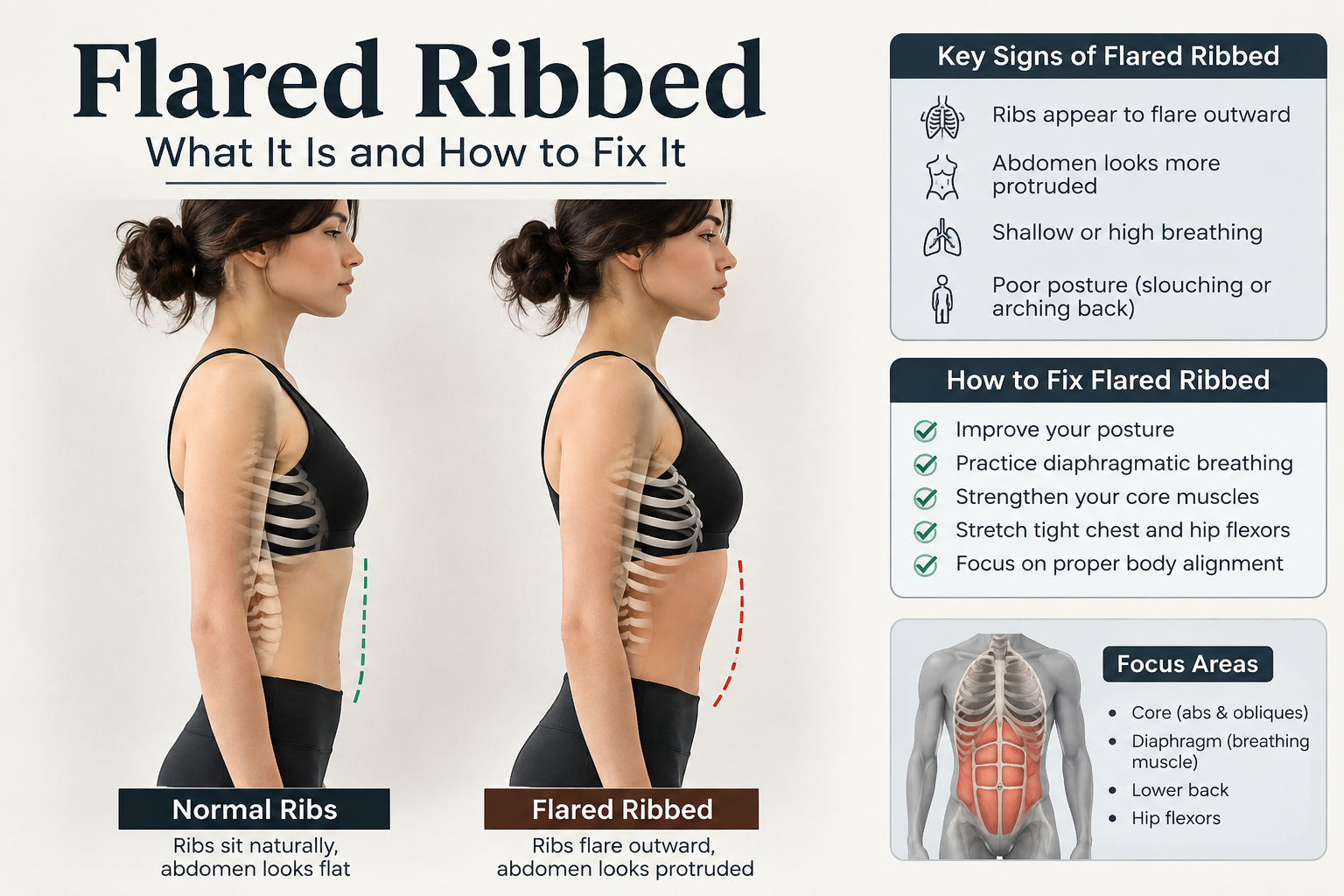
Flared ribs are a common postural appearance in which the lower ribs seem to angle outward rather than staying relatively aligned with the rest of the torso. Some people notice flared ribs when standing relaxed, while others see it more clearly when lying down, raising their arms, or taking a deep breath.
For many people, rib flare is related to posture, breathing mechanics, or the way the trunk and pelvis are positioned. Flared ribs can affect the appearance of your lower torso and posture. Flared ribs may become more noticeable when you stand, stretch, or take a deep breath.
However, not every prominent rib cage is a posture problem. The shape of your chest can also reflect your natural anatomy or an underlying chest-wall condition.
That distinction matters. Exercises may improve control, posture, and movement when rib flare is primarily functional, but they cannot simply reshape every type of chest-wall structure. Conditions such as pectus carinatum, for example, can cause the chest to bow outward because of changes in the cartilage connecting the ribs to the breastbone. Rib flare is often linked to posture, breathing mechanics, and core positioning.
The good news is that many people can improve the appearance and control of mild rib flare by working on breathing, abdominal strength, posture, and overall body mechanics.
What Are Flared Ribs?
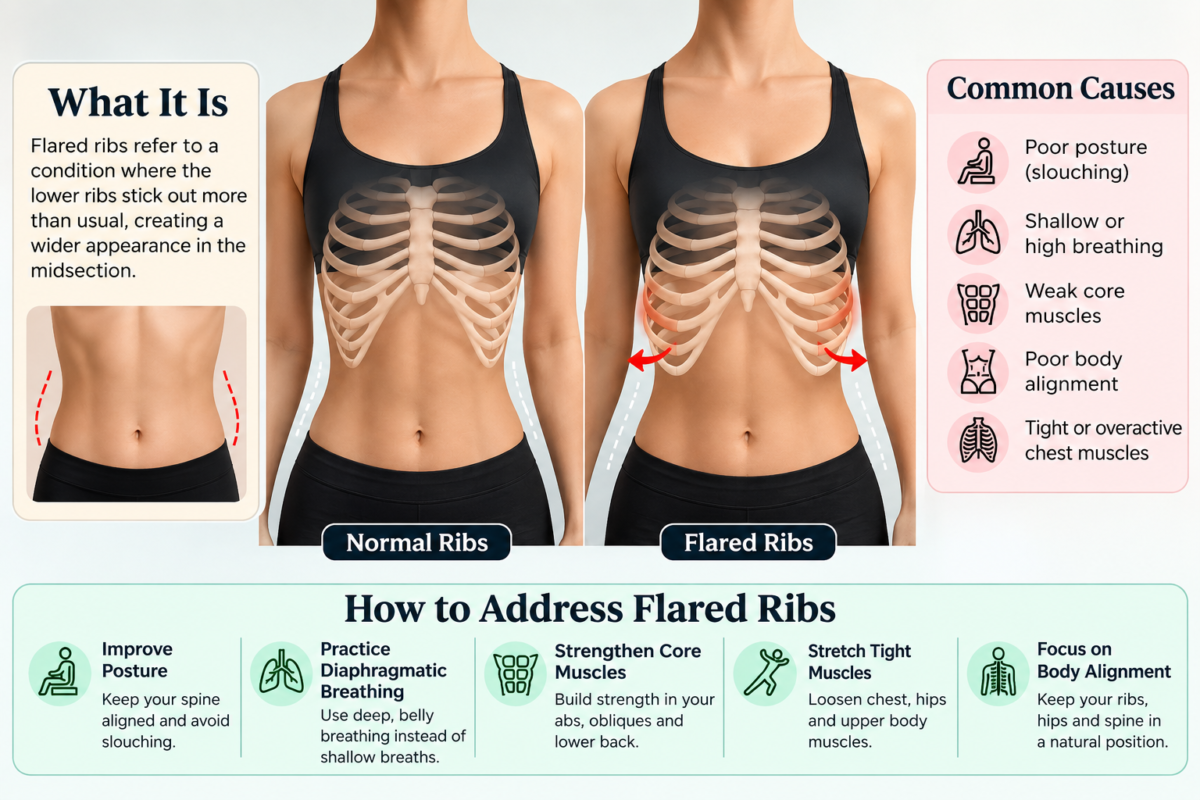
Flared ribs describe a visible outward position of the lower ribs, often around the front and sides of the rib cage. The appearance can become more noticeable when someone arches the lower back, pushes the chest upward, or allows the abdomen and rib cage to move without good trunk control.
Rib flare isn’t necessarily a disease or medical diagnosis by itself. It can simply describe a body position.
Several factors can contribute to the appearance, including:
- Poor postural habits
- Excessive lower-back arching
- Limited trunk control
- Breathing patterns
- Weakness or poor coordination of the abdominal muscles
- Pelvic positioning
- Individual skeletal anatomy
A physical therapist can evaluate posture, movement, strength, flexibility, and functional mechanics to determine what may be contributing to the problem.
Rib Flare vs. Chest-Wall Deformity
It’s important not to assume that every prominent rib cage is caused by posture.
Pectus carinatum, sometimes called pigeon chest, is a structural chest-wall condition in which the chest protrudes outward because of overgrowth of the cartilage connecting the ribs to the sternum.
If the shape of your chest has always been prominent, is becoming more noticeable, or is associated with pain or breathing difficulties, a healthcare professional can determine whether you’re dealing with ordinary postural rib flare or a structural condition. How to fix rib flare depends on improving posture, breathing control, and core stability.
What Causes Flared Ribs?
There isn’t one universal cause of rib flare. The appearance can result from several interacting factors.
Posture and Spinal Position
One common contributor is excessive extension through the lower back. When the pelvis and spine move into an exaggerated position, the lower ribs may appear to project forward.
This doesn’t mean you should constantly force your ribs downward. Instead, the goal is to develop better control over the position of your rib cage, pelvis, and trunk during normal movement.
Breathing Mechanics
Your rib cage naturally expands during inhalation and changes position during exhalation. Breathing involves coordinated movement of the diaphragm, rib cage, abdominal wall, and other muscles.
If someone habitually breathes with excessive upper-chest movement or struggles to control the rib cage during breathing, the ribs may appear more prominent.
Breathing exercises can help some people develop better awareness and control, but the appropriate technique depends on the individual’s movement pattern.
Abdominal Muscle Control
The abdominal muscles help stabilize the trunk and contribute to controlling the relationship between the rib cage and pelvis.
If your core muscles aren’t coordinating effectively during movement, your ribs may move into an exaggerated position during exercises such as overhead presses, squats, or planks.
This doesn’t necessarily mean your abs are simply “weak.” Coordination and technique matter just as much as strength.
How to Fix Rib Flare
If your rib flare is primarily related to posture or movement mechanics, the goal isn’t to physically force the ribs inward. Instead, you want to improve rib-cage control, breathing mechanics, trunk stability, and overall posture.
A physical therapist can assess your specific movement pattern and develop an individualized program. Physical therapy commonly addresses posture, strength, flexibility, movement, and functional limitations.How to fix flared ribs starts with understanding your posture and strengthening the muscles that support your torso.
1. Practice Controlled Breathing
One useful starting point is learning to breathe without constantly lifting or thrusting the chest.
Lie comfortably on your back with your knees bent. Relax your shoulders and allow your abdomen and lower rib cage to move naturally as you breathe.
During a slow exhale, gently allow the rib cage to settle without aggressively pulling your stomach inward.
The objective is control, not force.
Take several comfortable breaths and stop if you become dizzy, uncomfortable, or short of breath.
2. Improve Core Control
Exercises that teach you to stabilize your trunk while maintaining comfortable breathing may help improve rib-cage positioning.
Examples can include:
- Dead bugs
- Modified planks
- Heel taps
- Bird dogs
- Glute bridges
- Controlled abdominal exercises
Start with an easier variation and prioritize technique over repetitions.
If your ribs immediately pop upward when you perform an exercise, reduce the difficulty. You want to maintain control rather than compensate by excessively arching your back.
3. Strengthen the Glutes
The pelvis and rib cage work together as part of the entire trunk and lower-body system.
Exercises such as glute bridges and controlled squats can help improve overall movement mechanics. They don’t “push the ribs back into place,” but they can contribute to better trunk and pelvic control.
4. Work on Postural Awareness
You don’t need to maintain a rigid posture all day.
Instead, periodically check whether you’re standing with your chest excessively lifted and your lower back strongly arched.
Try to find a comfortable neutral position in which:
- Your shoulders remain relaxed.
- Your ribs aren’t aggressively pushed forward.
- Your pelvis feels balanced.
- Your breathing remains comfortable.
- Your spine isn’t held rigidly.
Good posture should feel sustainable rather than forced.
How to Get Rid of Flared Ribs
If you’re wondering how to get rid of flared ribs, the first thing to understand is that the answer depends on why your ribs appear prominent.
If the appearance comes largely from posture and movement habits, improving muscular control may make the rib cage look more aligned. If the appearance comes from your natural skeletal structure or a chest-wall deformity, exercise may not completely change the shape.
Focus on Movement Quality
Rather than performing dozens of “rib flare exercises,” focus on how your entire body moves.
For example, when performing a dead bug, don’t allow your lower back to excessively arch as your legs move away from your body.
Likewise, during an overhead movement, avoid automatically pushing your ribs forward to gain additional range.
The goal is to develop controlled movement without unnecessary compensation.
Avoid Extreme Corrections
One common mistake is trying to keep the ribs permanently pulled downward.
That can create unnecessary tension and interfere with normal breathing.
Your rib cage needs to move. It expands during inhalation and changes position during exhalation. Therefore, the goal isn’t to freeze the ribs in one position.
Instead, learn when and how they should move.
Be Consistent
Postural changes rarely happen overnight.
If your rib flare is related to movement habits, consistent practice may gradually improve your awareness and control. Think in terms of weeks and months rather than expecting a dramatic change after a few workouts.
A physical therapist can also adjust exercises as your movement improves.
How Can You Make Flared Ribs Normal?
If by “normal” you mean making your rib cage look less prominent, the answer depends on whether the appearance is functional or structural.
Functional rib flare may respond to improved posture, breathing, mobility, and strengthening. Structural changes are different and may require medical evaluation.
Understand Your Individual Anatomy
Human bodies don’t all have identical rib cages.
Some people naturally have wider lower ribs, different torso proportions, or more visible bony structures. A certain amount of asymmetry and variation can be completely normal.
Therefore, comparing your rib cage with photographs of fitness influencers or models can create unrealistic expectations.
Improve Rib and Pelvis Coordination
One useful training concept is maintaining comfortable coordination between your rib cage and pelvis.
For example, during a core exercise, imagine keeping your torso stable while breathing normally. Avoid exaggerating the movement by forcing your ribs down or flattening your back aggressively.
This approach can help you develop better control without creating unnecessary stiffness.
Strengthen the Entire Core
Your core includes much more than the abdominal muscles.
A balanced program can involve the:
- Abdominal muscles
- Obliques
- Back muscles
- Diaphragm
- Pelvic floor
- Hip muscles
Exercises that challenge stability while allowing normal breathing can be particularly useful for developing coordination.
Consider Professional Assessment
If you’ve tried changing your posture and exercise technique but your rib flare doesn’t change, don’t assume you’re doing everything incorrectly.
A qualified physical therapist can evaluate your posture and movement patterns. They can also determine whether the appearance is likely related to muscular control, spinal positioning, breathing mechanics, or another factor.
Physical therapists commonly assess alignment, strength, range of motion, movement, and functional activities before developing an individualized treatment plan.
Exercises That May Help With Rib Flare
There isn’t one universal exercise that “fixes” flared ribs. However, controlled exercises may help improve trunk stability and body awareness when posture or movement mechanics contribute to the appearance.
Dead Bug
Lie on your back with your knees bent and arms raised.
Slowly extend one leg while maintaining comfortable breathing and trunk control. Return to the starting position and repeat on the opposite side.
If your ribs lift dramatically or your lower back arches excessively, shorten the movement.
Glute Bridge
Lie on your back with your knees bent and feet on the floor.
Press through your feet and raise your hips while maintaining a controlled trunk position. Lower slowly.
The exercise targets the glutes while encouraging coordination between the pelvis and trunk.
Bird Dog
Start on your hands and knees.
Extend one arm and the opposite leg while trying to keep your torso stable. Return slowly and switch sides.
Avoid rotating your hips or arching your lower back.
Modified Plank
Start with a plank variation that you can perform while maintaining controlled breathing.
As your strength improves, gradually increase the difficulty.
The purpose isn’t to force the ribs down. Instead, focus on maintaining a stable trunk while breathing comfortably.
Can Exercise Completely Change Flared Ribs?
Not always.
Exercise can improve muscle strength, posture, movement control, and breathing mechanics, but it cannot guarantee a permanent change to the shape of your skeleton.
If the rib appearance results from a structural chest-wall condition such as pectus carinatum, specialized medical treatment may be necessary. In children and adolescents with mild-to-moderate pectus carinatum, external bracing can be used to gradually reshape the chest wall, particularly while the chest is still developing.
Severe or complex chest-wall deformities may require specialist evaluation and, in selected cases, surgical treatment.
This is why identifying the underlying cause matters before attempting an aggressive self-treatment program.
When Should You See a Doctor?
Most people who simply notice prominent lower ribs don’t have an emergency. However, you should seek medical evaluation if the change is sudden, painful, or associated with other symptoms.
Contact a healthcare professional if you experience:
- Persistent chest pain
- Significant difficulty breathing
- A sudden change in chest shape
- Rib pain after an injury
- Severe tenderness
- Unexplained swelling
- Increasing asymmetry
- Problems exercising because of breathing difficulty
Chest trauma accompanied by serious breathing problems requires urgent medical attention. Severe rib injuries can affect breathing and may require immediate treatment.
You should also avoid trying to manually force or “push” your ribs into a different position. Aggressive manipulation can cause injury and isn’t a reliable way to correct rib flare.
Frequently Asked Questions About Flared Ribs
Can flared ribs be corrected naturally?
If the appearance is related to posture or movement mechanics, exercises and improved body control may help reduce its appearance. However, structural chest-wall differences may not respond to exercise alone.
Do ab exercises fix rib flare?
Abdominal exercises can improve trunk strength and control, but they don’t automatically correct rib flare. Technique, breathing, posture, and the underlying cause all matter.
Does rib flare mean something is wrong?
Not necessarily. Rib prominence can be a normal anatomical variation or a postural pattern. However, pain, breathing problems, sudden changes, or significant chest deformity deserve professional assessment.
How long does it take to improve rib flare?
There is no fixed timeline. If the issue is primarily related to posture and movement control, consistent training may gradually improve your positioning and awareness. Structural conditions require a different approach.
Final Thoughts
Flared ribs can result from several different factors, so there isn’t one exercise or technique that works for everyone. When rib flare is primarily related to posture, breathing, or movement control, improving trunk stability, practicing comfortable breathing, and developing better body mechanics may reduce its appearance.
If you’re searching for how to fix rib flare, how to get rid of flared ribs, or how you can make flared ribs normal, focus on improving control rather than forcing your ribs into a particular position.
Most importantly, remember that not every prominent rib cage needs correction. Natural anatomy varies considerably between people. If your ribs are painful, changing rapidly, affecting your breathing, or appear significantly different from one side to the other, professional evaluation is the safest next step.
With the right assessment and a consistent approach, many people can improve posture, movement quality, and trunk control while developing a healthier relationship with their natural body shape.